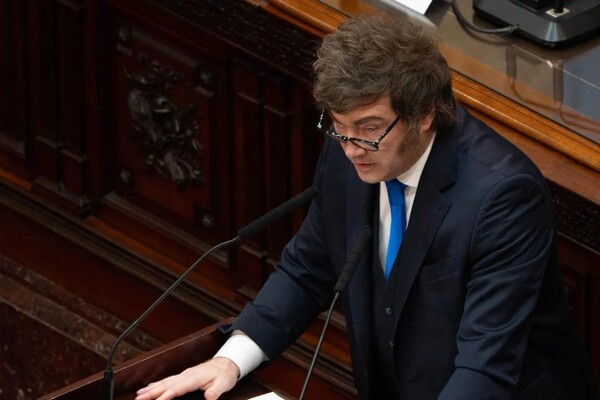
Even so, the President chose to see the glass as half full: for the Casa Rosada, the 0.979% wholesale inflation is much more than a fine number; it is a political banner in the middle of a central fight for the credibility of the economic program. Consumer inflation remains at levels significantly above 2%, and the pass-through of a wholesale improvement to the retail shelves has not yet appeared at the speed the economic team hoped for. The ruling coalition itself admits that disinflation on retail prices has shown a more persistent slowdown than expected. The President responded to publications by leaders and officials who interpreted that figure as an early validation of his forecast: that Argentine inflation could start with zero between August and the following months. The presidential reaction had the tone that has already become habitual in his digital communication. The wholesale price index focuses on goods and tends to react faster to certain movements in costs, the exchange rate, and foreign trade. While wholesale inflation marked the smallest increase since May 2025, when even a negative variation was recorded, retail inflation in February was again at 2.9%, exactly the same level as in January. In other words, the Government found in the wholesale data a signal to sustain its disinflationary discourse at a time when consumers' pockets still do not reflect that improvement with the same clarity. The difference between the two measurements is not minor. There, he again defended his monetary thesis and assured that once the quasi-fiscal deficit is eliminated and the growth of the broad monetary base is curbed, inflation should extinguish itself over time. Within the ruling coalition ecosystem, it was highlighted that if the record is taken with two decimal places, monthly wholesale inflation was 0.979%, that is, technically it started “with zero”. In that speech, he again stated that he remains convinced that in August inflation could start with zero. The dissemination of the February wholesale price index gave political air to President Javier Milei, who celebrated on social networks a figure that the ruling coalition read as a sign of support for its economic roadmap. The retail index, on the other hand, also includes services, regulated tariffs, and other components that adjust with more lag. He also said he pays special attention to wholesale inflation because, in his view, it anticipates retail inflation and is not as contaminated by the tariff issue. Minister Caputo reinforced that same narrative. Later, he insisted that wholesale prices anticipate future retail behavior, although he acknowledged that the consumer price index still carries distortions derived from tariffs and other regulated prices. This contrast explains much of the official enthusiasm. That is why, within the ruling coalition, it is repeated that the IPIM acts as a partial preview of what could later be seen in the CPI, although that relationship does not always translate linearly or automatically to the final consumer. That logic also underpins the speech that Milei delivered on March 16 at the Córdoba Stock Exchange. The Government understands that this data is an additional argument to defend the fiscal balance, monetary anchor, and deregulation of relative prices plan. However, the picture does not yet look closed. He highlighted that the monthly increase in the IPIM was the smallest since May 2025 and emphasized that it is only the third time since June 2020 that this index has shown a monthly variation of 1% or less. INDEC reported that the Wholesale Price Index (IPIM) registered a rise of 1.0% in February, with a year-on-year variation of 25.6% and an accumulated 2.7% in the first two months of the year. Within that result, national products increased by 1.3%, while imported products fell by 2.7%, a movement that was quickly capitalized by the Casa Rosada. The political reading of the data was not long in coming. “Tsunami of chanes,” he wrote on X, and before that, he had celebrated the drop in wholesale indicators with another message in which he listed the IPIM's 1%, the IPI's 0.7%, and the IPP's 0.7%, in addition to again praising the Minister of Economy, Luis Caputo, whom he considers the main executor of the stabilization program. On that point, the message that Milei decided to amplify was built. Buenos Aires - March 18, 2026 - Total News Agency - TNA -.